==pla|\|ing lakes==










Friday, January 31, 2003
Andrew Jarecki's Capturing the Friedmans documentary [robot wisdom]Jarecki (who as a sometime musician and former CEO of Moviefone.com may have the most unlikely background of any director at Sundance this year) proves a smart, assured, unsentimental documentarian who never sides with any one interpretation of events, never stops reminding us of Arnold Friedman's past transgressions.
He has us pity the implosion (and, at times, self-immolation) of the Friedmans without ever once asking us to forgive the heinous nature of Arnold's and Jesse's possibly real, possibly imagined crimes. By remaining so resolutely objective, Jarecki forces us to put ourselves in the Friedmans' position and ponder how there, but for the grace of God, might we go.
3:15 AM - [Link] - Comments ()
Victim of Polanski rape case would like um closure
3:12 AM - [Link] - Comments ()
Copyright lunacy file
Finnish kindergarteners charged fee for singing songs [Undernews Jan 29]
1:03 AM - [Link] - Comments ()
Thursday, January 30, 2003
Had a pretty bad 24 hours, psychologically. Music helps now.Live on tomorrowMusic is too important to be doled out by gangsters.
Put me in the shower, pull me out of bed.
Am I only dreaming, or did I wake up dead?
Throw me in the garbage, shackled up in chains.
But I still got my boots on
So I can walk away.
A heartbeat says you haven't died.
You gotta try to stay alive.
Leave me to the vultures.
Throw me to the wolves.
I'll live on tomorrow
And purity of soul.
Dump me in the ocean,
Tied to a piano.
But you forgot to rip my heart out
Before you let me go.
A heartbeat says you haven't died.
You gotta try to stay alive.
Lock me in the basement,
Without anything to eat.
You can hurt my body,
But you can't hurt me
Juliana Hatfield
Thanks to sing365 for the lyrics.
3:06 AM - [Link] - Comments ()
Wednesday, January 29, 2003
This review of The Little Friend (and The Secret History as well really) is pretty much on the money
I gave up on TLF after about 150 pages, for reasons I'll go into when I have more energy. For now, read Ruth Franklin (above link).
4:00 AM - [Link] - Comments ()
Tom Carson's new tour de force, Gilligan's Wake
I used to read Carson's reviews and so forth in the Village Voice and the short-lived but fondly remembered Soho Weekly News in the 80s. I always liked him, and I'd like to like his book. But the Joycean wordplay (and from my look at it today, it's got little of Joyce's hyper vibrancy or whatever it was he had, as David Kelly noted) is way too mental or even precious for me these days.
But it's chock full of pop culture references, and many people will probably love the shit out of it.
I also checked John Laurence's The Cat from Hué: A Vietnam War Story, after seeing him on Booknotes on the weekend, and that's more up my street. If I can get through at least one of my Intel tomes. . .
For pop satire in book form, I'll stick to Victor Pelevin for now. Maybe that's partly because I've just had enough American culture for now. Maybe my sense of humor is closer to the darker, more disorienting Slavic acid-etching of Pelevin.
I just wish I read Russian, because I know I'm missing a lot in translation.
Fiction has to be right on my wavelength these days or I just can't stay with it.
3:38 AM - [Link] - Comments ()
Tuesday, January 28, 2003
Toronto's Art Gallery of Ontario (the 10th largest museum in North America) hires Frank Gehry for a re-design, as it expands with a new bequest and aspires to world-class status
Gehry is from Toronto originally.
2:48 AM - [Link] - Comments ()
A new book argues that the fragmentation of modern life began with the ear, not the eye
From a review:The aural experiences of yore were often communal - a congregation listening to a sermon or a choir, or an audience listening to a play. They happened in a specific time and place, and when they were over, they were over. Anyone who was wool-gathering during the second act simply missed it. Period.The reviewer notes that we once had to learn to speak over the telephone.
Nowadays, however, we have a soundscape that is as much a "built environment" as is a city skyline. But the myriad forms of sound recording and amplification make it a fragmented soundscape. Instead of an audience that, as one, laughs or cries or sits enraptured, we have collections of individual auditors, each with his or her own headset. This fragmentation is like similar phenomena in other modern media and art forms - such as flashbacks that cinemagoers once had to learn to "read," or photo montage and stream-of-consciousness literature.
Hard to imagine a world so unified-in-hearing now. This is why artists like Laurie Anderson prefer live audiences.
Being an opinionated, firecely independent sort myself, I shudder at the thought of having to listen to the music the majority likes, for instance. But some communal experience might go a long way toward healing the alienation and anxiety we all feel.
Even in the 60s and 70s, the music I listened to was a shared experience (even if you weren't at a live concert), in a way it isn't now.
But how does that organically occur? It couldn't work any way but through a natural flow.
It would have to grow out of an intention. A shared intention.
Which seems to be a trend: collaborative art, that's made by a group or interacts with the audience.Lawrence Rinder, the Whitney [Biennial's] curator, says of this team mentality, "There's definitely something in the air, particularly with the younger generation." Edward Kerns, an art professor at Lafayette College in Easton, Pa., agrees that "it's a generational thing. Students who grow up with networking systems are used to working together."This gives me a good feeling.
[...]
Canadian artist Jillian Mcdonald, working out of a storefront in downtown Manhattan, invites passers-by to tell her their fears, then sews a protective mantra in gold thread into a garment for them.
"Without participation, there's no art - it depends on interaction," Ms. Mcdonald says. "There's nothing like communicating with other people," she adds. "It's more rewarding than working alone."
Ray Kass, founder and director of the Mountain Lake Workshop at Virginia Polytechnic Institute in Blacksburg, Va., has invited visiting artists to work with the local community since 1983. John Cage, folk artist Howard Finster, and French artist Jackie Matisse are a few who've worked alongside students and Appalachian residents.
Two hundred locals attended kitemaking day with Ms. Matisse. More than 700 viewed her artwork, "Kites Soaring In and Out of Space," in a virtual-reality cave. Focusing on a discipline-centered activity to get rural residents involved, Mr. Kass says, "has had the phenomenal effect of creating a kind of local culture."
2:25 AM - [Link] - Comments ()
Monday, January 27, 2003
Music retailers figure this here music file stuff might be worth lookin' into
11:06 AM - [Link] - Comments ()
Sunday, January 26, 2003

German crop circles
4:59 AM - [Link] - Comments ()
Saturday, January 25, 2003
Nice review of John Szwed's new Miles bio
It may be that this is the best one book to read about Miles (there are quite a few), just as David Thomson's book about Orson Welles is the best one book about him.
Since this book points to his work in the 50s as his best, I suggest Paul Tingen's Miles Beyond: Electric Explorations of Miles Davis, 1967-1991 as an accompaniment. It's the one I've read, and whether jazz aficionados like it or not, Miles work in the 70s is important to me and a lot of other people right now.
Not to say what's best or anything. Just that Miles doesn't just belong to the jazzbos.
NOTE: As you may know, salon has changed their access policy. You can view the whole site now (without paying or Premium access), if you click through a 4-pane Mercedes ad (that's what it is today anyway). You'll have to do this to get the whole article linked above. I discovered this just now because they've walled off Tom Tomorrow's comic -- hilariously, since the first time I've encountered this was the time I read his luxury American gas-guzzler toon.
1:11 PM - [Link] - Comments ()
Somehow I don't really want Nick Hornby's Songbook to be relevant to me, but there it is
Probably just borrow it though.
Maybe it's a generational thing. Hard to admit music can mean that much to you. Or that it doesn't often enough.
12:05 PM - [Link] - Comments ()
Friday, January 24, 2003
73-year-old Chuck Barris muses on his um checkered past
I admit it -- I thought he died years ago. He survived lung cancer, apparently, though the article doesn't go into the details of that.
3:49 AM - [Link] - Comments ()
Some nice pics of Mayan ruins on the northern peninsula, Guatemala and Belize [Earth Alchemy message board]
None of Palenque or Chichen Itza though. But the sites shown are less well known, and harder to find.
3:20 AM - [Link] - Comments ()

I have to admit, despite my general aversion to tall buildings, it would be hilarious and cool to see a Gaudi building erected in Manhattan
Doesn't look dated at all. And about a 1000mprovement on the design of the original WTC.
Not sure how practical it is but I don't give a damn either. That would be good too -- something impractical on Wall St.
3:10 AM - [Link] - Comments ()
Tuesday, January 21, 2003
We're all going to jail
Verizon ordered to turn over name of file downloader
8:19 PM - [Link] - Comments ()
2002 Top Ten albums by artists on the experimental fällt label
I listen to some stuff like this, but there's way too much to hear, never mind afford.
I do like what I've heard from Mileece, Eliane Radigue, some of Tomas Jirku, Janek Schaefer is very good -- his Above Buildings is on my wishlist.
2:41 AM - [Link] - Comments ()
Monday, January 20, 2003
R.I.P. Al Hirschfeld
99 years!
An American Institution.
1:41 PM - [Link] - Comments ()
Dan Gillmor on the Supreme Court's pro-racketeering copyright decisionSwipe a CD from a record store and you'll get arrested. But when Congress authorizes the entertainment industry to steal from you -- well, that's the American way.
We learned as much Wednesday when the U.S. Supreme Court ruled that Congress can repeatedly extend copyright terms, as it did most recently in 1998 when it added 20 years to the terms for new and existing works.
The law, a brazen heist, was called the Copyright Term Extension Act. It was better known as the Sonny Bono act, so named after its chief sponsor even though Disney and other giant media corporations were the money and muscle behind it.
Who got robbed? You did. I did.
2:34 AM - [Link] - Comments ()
Key archaeological find in Ireland: huge underground temple under Tara Hill [incublogula]
1:53 AM - [Link] - Comments ()
Ernest Glitch's experiments and other um revisionist science at Lateral Science [Incublogula]
1:43 AM - [Link] - Comments ()
Sunday, January 19, 2003
Warhol and Ballard would be proud
Combination bonsai trees and "crashed" model cars = Crash Bonsai [Undernews]
7:03 PM - [Link] - Comments ()
The end of anonymity: product-embedded RFIDs (radio frequency identification) [Undernews]...RFID tags...typically include a 64-bit unique identifier yielding about 18 thousand trillion possible values. KSW-Microtec, a German company, has invented washable RFID tags designed to be sewn into clothing. And according to EE Times, the European central bank is considering embedding RFID tags into banknotes by 2005.
It becomes unnervingly easy to imagine a scenario where everything you buy that's more expensive than a Snickers will sport RFID tags. That raises the disquieting possibility of being tracked though our personal possessions. Imagine: The Gap links your sweater's RFID tag with the credit card you used to buy it and recognizes you by name when you return. Grocery stores flash ads on wall-sized screens based on your spending patterns, just like in "Minority Report." Police gain a trendy method of constant, cradle-to-grave surveillance.
You can imagine nightmare legal scenarios that don't involve the cops. Future divorce cases could involve one party seeking a subpoena for RFID logs--to prove that a spouse was in a certain location at a certain time. Future burglars could canvass alleys with RFID detectors, looking for RFID tags on discarded packaging that indicates expensive electronic gear is nearby. In all of these scenarios, the ability to remain anonymous is eroded.
6:54 PM - [Link] - Comments ()
Cries from the Asylum
Mad Hillary demands ISPs pay for customers' downloads [drudge]
11:20 AM - [Link] - Comments ()
Deer in the headlights
Apparent insider says Muzik biz saw online music & file-sharing coming and let it go [og]
He also claims the labels are jamming the networks with junk, though I'd heard of this a while back and figured it was tried for awhile and abandoned.
1:54 AM - [Link] - Comments ()
Saturday, January 18, 2003
Apple whacks i-Tunes P2P plug-in developer
So much for Apple's populist blush.
10:37 AM - [Link] - Comments ()
Good Zippy today: "Humiliation ROCKS, man!"
If you miss it today, you'll have to wait a couple weeks and go here -- as far as I know.
10:06 AM - [Link] - Comments ()
Alex catalogue of etexts allows content search, variety of formats [refdesk]
Pdf, Palm Pilot, Newton, Rocket all supported.
And just for the record: the Supreme Court sucks.
10:01 AM - [Link] - Comments ()
NBA edges closer to pro wrestling territory
Class war declared by Shaq:"The unfortunate thing is it had to be decided by them," O'Neal said of the officials. "A whole bunch of people who paid a lot of money had to see a game that was decided by someone who doesn't make a lot of money. That's unfortunate."Heh.
9:47 AM - [Link] - Comments ()
Friday, January 17, 2003
Historical corrective to Gangs of New York's Anglo-Irish foreshortening
Clearly the ethnic mix and the relations between them -- particularly the slavery/blacks component -- was more complex than Scorsese apparently shows. I imagine his simplification and license with the history was necessary to prevent the movie from being 10 hours long for one thing. It certainly could have been more accurate, but this is a piece of American history most people didn't even know existed til the film was released. It's only a beginning, and historical accuracy has never been Hollywood's um strong suit. If Scorsese didn't go a bit out of his way to make the central narrative simple and entertaining, how many people would have gone to see the damn thing anyway?
That being said, hopefully the History Channel or PBS (which just premiered a fine mini-series on 19th century Chicago) will delve into the deeper complexity of this extraordinary time and place.
Of course, if Americans had more of an interest in their history to begin with, we wouldn't have the problem to begin with, would we? Perhaps this is what really angers Foreman -- that American disinterest in history gives movies based on history disproportionate influence on what we think of our past.
5:13 AM - [Link] - Comments ()
Thursday, January 16, 2003

Back at Portage, a link to the New York Public Library Image Gate, which you can promptly lose yourself in
Gorgeous.
7:42 PM - [Link] - Comments ()
As coyotes and humans expand and overlap territories, the price might be your pet
4:26 AM - [Link] - Comments ()

Fastmartblrtok u no?
Fast-talkers seem smarter -- and Hollywood uses quick scenes and chatter to skew towards younger audiences [u]This thinking was explained by the producer of a popular TV show on the WB network, "Gilmore Girls," which features a mother-daughter duo who are more like friends than like parent and child. The elder Gilmore, Lorelai, became a single mother while still in her teens; now she is in her early thirties and her daughter, Rory, is a teen. The creator, Amy Sherman-Palladino, told the Wall Street Journal recently that zippiness is the motivation for many aspects of "Gilmore Girls:" no close-ups (they slow things down); frequent shots of characters talking as they walk from place to place; and scenes shot over and over to shave a few seconds off the already dizzying pace. Screenwriters traditionally figure a page of dialogue to a minute on air; Sherman-Palladino figures 20 to 25 seconds a page.Good article by Deborah Tannen, who also spots IM (Instant Messaging) talk as a bonding strategy.
Surely the fast-forward speech of "Gilmore Girls" helps the characters sound like hip teenagers, just as their jeans and midriff-baring blouses clinging skin-tightly to their teen-thin bodies help both "girls" look like teens. But network shows aimed at fully adult audiences, like the wildly popular "West Wing," follow the same trend. Hollywood producers, according to the Wall Street Journal article, think people seem smarter if they talk faster.
wrd
4:05 AM - [Link] - Comments ()
Wednesday, January 15, 2003

I've always liked Charles Sheeler's work, though it's hard not to feel ambivalent about someone who (intentionally or not) glamorized industrial landscapes
I guess I've been fascinated with them too though. I remember being fascinated by a photo of myself next to a giant hydro carbine in Canada as a kid.
This good short piece on Sheeler has a link to a Karen Lucic book which purports Sheeler's ambivalence as well, apparently.
There's also a link to Interior, which I like a lot. Trippy.
2:13 AM - [Link] - Comments ()
Confessions of a Dangerous Mind looks pretty good
Nice to see George Clooney do so well his first time out directing. Even if it's not as intriguing as Sterritt makes it sound, doing a passable job directing a Kaufman screenplay is an accomplishment for even seasoned directors, I think.
Since the source material kind of gices you license to do what you want, I'd have taken it into a darker, more Phildickian direction probably. It's got that whiff. . .
1:54 AM - [Link] - Comments ()
Bruce Perens' "Open Source" series of books to be offered as free ebooks by Prentice-Hall
1:45 AM - [Link] - Comments ()
On a personal note: I've tried to list books I'm reading only when I figure I'll finish them. Lately I've been so restless and moody, pleasures like reading have seemed closed off to me.
So it will be a record of my unease more than what I get all the way through, for now anyway.
It's very frustrating, because reading has always been vital to me, and things are definitely unsettled when this happens. And I have so many books I want to read.
The "Viewing" section lists what I've actually completed; for instance, I didn't list the Scorsese apperciation of Italian cinema (My Voyage to Italy) til I'd actually finished it, months after I started (it's over 4 hours long). Still haven't finished Open City yet -- though I watched Germany in the Year Zero immediately. Some of this is because of limited access to the TV, for reasons I won't go into.
1:07 AM - [Link] - Comments ()
"MAKE MUSIC LIKE BRIAN ENO OR BRITNEY SPEARS" -- from a recent ZiffDavis newletter, referring to an article on building a home studio
Oh dear.
12:51 AM - [Link] - Comments ()
Tuesday, January 14, 2003
Damn. Looks like we'll have to wait til at least 2005 for Turrell's Roden Crater site to open
He'll have exhibits in Pittsburgh, Seattle, Nagoya Japan and Unna Germany this year though. The 2 outside the US are group shows.
Here's a good interview, if you're unfamiliar with Turrell.I make spaces that apprehend light for our perception, and in some way gather it, or seem to hold it. So in that way it's a little bit like Plato's cave. We sit in the cave with our backs to reality, looking at the reflection of reality on the cave wall. As an analogy to how we perceive, and the imperfections of perception, I think this is very interesting.
And there is the making of Plato's cave literally-at New Grange in Ireland, or Abu Sembal where you don't have a pointing sculpture like Stonehenge. Instead you have an architectural space that is arranged to accept an event in light on the horizon. When that event in light occurs on the horizon there is an event in light, inside that space.
This then became the camera obscura, which appeared in many European towns. They would have these, and eventually even created panoramas and dioramas. The "camera lucida" and the "camera obscura" were what artists used to actually make this Western painting space.
We made this eye that sees for us, like the camera, and this is very much a part of how we organized our culture. Of course it became this holder of truth. I mean in a court of law you take a photograph, and you can use it as evidence.
3:48 AM - [Link] - Comments ()
Top 2003 calendars in the US [CSM]1. George W. Bush (daily)I picked this one (that's a good price too), because the artist caught my eye.
2. Sports Illustrated Swimsuit (wall)
3. German Shorthaired Pointers (wall)
4. "Harry Potter" movies (wall)
5. The Far Side (wall)
6. 365 Cats (daily)
7. Thomas Kinkade - Painter of Light (wall)
8. "Lord of the Rings - The Two Towers" (wall)
9. Dilbert (daily)
10. FDNY Firefighters (wall) - Associated Press
I can't believe how many people are staring at shrub every day. *shiver*
3:15 AM - [Link] - Comments ()
New tech/music industry agreement may end the clearly useless attempt to build copy-protection into hardwareThe agreement, expected to be announced Tuesday in Washington, contends that U.S. laws do not need to be amended, for example, to permit consumers to make backup copies of compact discs they purchase or copy songs onto handheld devices. The technology industry also will announce its support for aggressive enforcement against digital pirates.Could be a major step forward, though it could kaibosh Zoe Lofgren's bill which "wants permission for consumers to sell or give away copies of music or movies they purchase, and to impose protections for consumers who break locking controls that violate these rights."
Under the plan, future generations of entertainment devices won't be required by law to have locking controls that make it more difficult to copy digital entertainment. Technology companies have complained that the locking devices are too expensive and complex.
The deal attempts to heads off government intervention in the rising debate over what consumers can do with copyrighted material they have purchased.
The MPAA did not take part in the agreement.
2:17 AM - [Link] - Comments ()
Israeli geologists claim a recently uncovered stone tablet is the first physical proof of Biblical history
It details repair work on Solomon's Temple, supposedly, and stirs up the debate about Old Jerusalem's historical provenance.
2:07 AM - [Link] - Comments ()
Looks like Vonage has the first decent online phone service, though it's $70 just to sign up
You need broadband, natch. $40/month gets you unlimited US long distance, $26/month 500 minutes.
Check the article, which goes into detail (and tells you what the deal is if you love outside the US). The writer loves it, says the sound quality exceeds regular phone service (not too hard that).
2:00 AM - [Link] - Comments ()
Make sure you sign up for the price-fixing settlement refund
If you bought music between '95 and '00, you're eligible. Probable refund is between $5 - $20, though if enough people sign up and the refund is less than $5, the money goes to "music-related programs" or whatever.
At least you'll be telling the MusicMobsters you're watching them.
I don't feel this is near enough, but they'll probably be bankrupt soon enough anyway.
The deadline is March 3rd, and few have signed up so far.
1:54 AM - [Link] - Comments ()
Monday, January 13, 2003
New frontiers in corporate hegemony over national borders
US MusicMobster suit against Kazaa OK'd by judge
Corporate use of UN army to follow.
Just kidding. Right?
11:03 AM - [Link] - Comments ()
Sunday, January 12, 2003
Researching musical notation in the wall carving and the possibility of buried relics in Masonic/Knights Templar mecca Rosslyn Chapel
3:22 AM - [Link] - Comments ()
Saturday, January 11, 2003
Doran Wittelsbach's magazine Bloody Beautiful takes up the Virtual Victorian lifestyle pioneered by David McDermott and Peter McGough back in the 80s
McDermott/McGough were actually part (peripherally) of the late 70s/early 80s East Village art scene, with Madonna, Keith Haring, Ann Magnuson and Laurie Anderson. I had a book that gathered them all together but it's passed out of my hands.
Interesting, from a distance anyway. The Satanist connection is um off-putting.
8:57 PM - [Link] - Comments ()
Renaissance Man Jim Steranko
8:37 PM - [Link] - Comments ()
R.I.P. Maurice Pialat
I saw ? nos amours years ago on video, which I think was my introduction to Sandrine Bonnaire, who was very intense, like Pialat. He made difficult films and didn't pull many punches. Bonnaire and Gerard Dépardieu starred in Sous le soleil de Satan, his most (in)famous film, I believe.
7:36 PM - [Link] - Comments ()
A 16 year-old college student in Ireland has developed a browser that is 5 times faster than (I assume) IE
Can't wait to get my hands on this baby.
7:25 PM - [Link] - Comments ()
Hard to believe the Brits are so shocked to find out Kate Winslet was airbrushed for a GQ cover
But perhaps it just points out that the image industry and the woman on the street are not on as easy terms as they once were. That can only be a good thing.
4:24 AM - [Link] - Comments ()
Thursday, January 09, 2003
A diverting selection of the 10 Best Books of '02 from the Baltimore Citypaper
Several titles here I hadn't heard of.
11:11 PM - [Link] - Comments ()
Microsoft Reader cracked
10:32 PM - [Link] - Comments ()
10 Tips for Digital Photographers [the null device]
10:18 PM - [Link] - Comments ()
You're hearing it here...too: Cory Doctorow's Down and Out in the Magic Kingdom is downloadable (free!) in several formats
I don't even know when I'll read it (I'm not getting into much recent SF really), but if I want to, it's there. And if I really like it, I'll get the book.
Thanks, Cory.
10:15 PM - [Link] - Comments ()
A couple links from the In erz?neTechnoccult
IncuBLOGula (the ONG's Hat people)
3:08 AM - [Link] - Comments ()
ReferralsSiblings Positive Effects of being the olbers childMy other site gets more colorful referrals, and more of them.
chung king express sociology
labia art galley
vulva punishment shocking
10mb porno films
chauncey gardiner mp3
ridley scott alien ambient music experimental
planing things to go to missouri
pictures of platypus tracts
Divine secrets of the Ya Ya Sisterhood skins for windows
poetry on lakes
museums motorization
password username plump
What influenced Annie Leibovitz's style of photography?
black teenagers commit street crimes in London
planing a poem
dropdown ads
family planing picture
"npr" "turkey hotline"
adult kickball leagues
eyeless enron
closeted men maui
brain planing
lakes in vietnam
doo rags in uk
dada: warning transport
2:16 AM - [Link] - Comments ()
Wednesday, January 08, 2003
Nice LA Weekly article on David Rees
Al the proceeds form his book go to de-mining Afghanistan -- though he's not exactly rich."Get Your War On" has been attracting that kind of traffic since two weeks after Rees started it, a heavy load for the servers at his Web host. Frequent crashes have led some to suspect that Rees has been censored by the FBI, the CIA or the not-yet-extant cultural-control department of the Office of Homeland Security. "I start getting e-mails and phone calls from people saying, 'Oh my God, they finally got you! Just let me know where you are and what you need and I'll spring you.' And I'd have to tell them, 'No, I haven't been censored. It's just my fucking Web host.'"
3:13 AM - [Link] - Comments ()
The 50-year expiration on copyright in Europe promises to unleash a flood of releases from the early 50s -- much to the squonky chagrin of the RIAA
2:19 AM - [Link] - Comments ()
Anthropologists deflate the patriarchy
Foraging and scavenging were more the rule for early man than hunting, according to new studies
2:14 AM - [Link] - Comments ()
DeCSS programmer acquitted on all charges
12:27 AM - [Link] - Comments ()
Monday, January 06, 2003
Lost in translation
Looks like if you want to read Stanislaw Lem's Solaris you have to learn Polish -- the only English translation is copped from a bad French one. Cold War weirdness and misunderstandings seem to follow him around like the rain cloud dogging Pigpen in Peanuts [FAS]Lem also began contributing essays on English-language sci-fi to scholarly journals and fan magazines alike. These essays were often acerbic: While he admired the work of Philip K. Dick, Lem saw himself as the heir to Kafka and H.G. Wells, so he had little regard for those mere hacks who wrote commercial fiction for the pulps.The short article is worth reading in its entirety.
Tensions with his American colleagues came to a head in a bizarre international literary incident. In 1973, in an effort to promote "international goodwill," the Science Fiction Writers of America (SFWA) conferred an honorary membership upon Lem, a distinction that had previously been given to only one other foreign writer, J.R.R. Tolkien.
But in 1975, the writer Philip Jose Farmer, whose sexually frank thrillers Lem had criticized, raised objections to Lem's honorary membership. Farmer's concerns were echoed by an addled Philip K. Dick, who was experiencing fits of paranoia at the time. Dick maintained that Lem had embezzled royalties from a Polish translation of Dick's 1969 novel Ubik. "The honorary voting of Stanislaw Lem to membership is the sheep voting the wolf a place at the communal hearth," Dick warned SFWA members in '75. "They certainly must be licking their chops back in Krakow right now."
4:33 PM - [Link] - Comments ()
$20 for a review
nyrock.com is upfront about having critics for sale -- it's all they do
4:07 PM - [Link] - Comments ()
Hollywood to flip switch on digital cable boxes, preventing recording of certain contentHollywood's new strategy is likely to affect everyone from computer-adept users of online music services to the average couch potato. The digital future, hailed as more convenient and of higher quality than the scratchy, fuzzy analog past, is coming with multiple strings attached.
Already, people are finding unfamiliar constraints on how they can consume familiar media: listen to music on your PC, but do not try to copy it to your MP3 player; watch a movie in your home as often as you want for 24 hours ? because after that it will evaporate into the ether; marvel at your plasma-screen TV, but be prepared for your picture quality to be diminished if you do not have the latest model with anti-piracy equipment.
2:32 PM - [Link] - Comments ()
R.I.P. Conrad Hall
Might be the only reason I watch Road to Perdition. I just taped The Professionals last night, oddly enough.
I didn't know he was born and raised in Tahiti, but that accounts for the light in Hell in the Pacific and Tequila Sunrise (another film enjoyable mostly for the cinematography). And his father wrote Mutiny on the Bounty!
Thanks Mr Hall.
3:36 AM - [Link] - Comments ()
Sunday, January 05, 2003
I hadn't even heard about the death of opensource/P2P pioneer Gene Kan in June [edwardmillerdotorg]
Not that I keep up with this area like I was a programmer, but these people have yet to get their due. I'm sorry he won't be here to collect his.
3:17 PM - [Link] - Comments ()
Do not resolve and refit the product optionally due to safe reason.
Awards for worst tech manuals [Undernews]
2:57 PM - [Link] - Comments ()
Grammar police spray their territory: net illiteracy attacked [Undernews]Hey, if it made e.e. cummings look like a visionary, surely it'll do the same for you, right? Wrong. It makes you look like a lazy fuckwit. (Unless you demonstrate that you can use the shift key: for instance, by using characters that demand it, like double quotes. Then it makes you look like a pretentious fuckwit.) Even if you somehow manage to pull off the no-caps style with grace and flair, the best impression you will make is that of a fuckwit admirer of e.e. cummings. That puts you one up on ninety-eight percent of the Internet, but you're still a fuckwit.
1:18 PM - [Link] - Comments ()
Old classical music (when is that term going to expire?) label Vox reissues long-out-of-print albums on CD -- by demand, over the Net [Undernews]
When will pop labels get a clue?
1:02 PM - [Link] - Comments ()
In case you don't keep up with the infrequent but invigorating metascene: Lou Reed on, well, the 60s really, though ostensibly about the music
Read this Aspen piece and Thompson's FALILV for the most potent dose of what the 60s were if you actually lived through them. And had ears.
Funny how all the darkness that the Velvets were compares to the obvious ecstatic glow Reed emanates here.
Funny how close your eyes' poll of the best album of '67 had The Velvet Underground and Nico getting 3X the votes of Sgt. Pepper.Of course it had to happen, it really had to happen, it was the natural end to Beethoven's Ninth. Everyone was getting sicker and looking like a wolverine while the people pushed colleges. Dirty buildings with lawns for people to lie on blankets. Well-groomed wasps or purposefully disheveled sensitives reading Spengler. But meanwhile everything was dead. Writing was dead, movies were dead. Everybody sat like an unpeeled orange. But the music was so beautiful.
11:33 AM - [Link] - Comments ()
Proposed Australian solar tower project website
3300 ft. high (twice the Toronto CN Tower), 300 ft. wide. The site is about 470 miles west of the national capital Canberra in southeastern Australia. Completion 2006.
Seems like solar and wild power would be naturals there.
3:39 AM - [Link] - Comments ()
Saturday, January 04, 2003
NSFC awards: The Pianist, Walken, Diane Lane
6:43 PM - [Link] - Comments ()
More lighthearted family fare from M. Cronenberg
Early review of Spider
Ralph Fiennes, Miranda Richardson in dual roles, shades of Eraserhead & The Cabinet of Dr Caligari.
Love that twisted Canadian chill.
4:32 AM - [Link] - Comments ()
R.I.P. Ian McNaughton
Monty Python director passes from injuries in auto accident.
4:19 AM - [Link] - Comments ()
Friday, January 03, 2003
If you were/are a fan of Throbbing Gristle, there's a new 24 CD(!) compilation of their live shows available from Mute
Only $286!
There'a a new studio comp (The World According to Throbbing Gristle) coming out in June too.
Boy did I get strange looks just mentioning the name Throbbing Gristle in the 70s. . .
2:05 AM - [Link] - Comments ()
Appropriately astounded review of Read and Burn 02What band could have released not one, not two, but three historic albums (in as many years), each so different from the one that came before, simultaneously spelling out the brittle aesthetics of England's burgeoning punk movement and, in nearly the same breath, eclipsing them while the rest of the pack was still busy learning to tune their guitars? What band would be willing to then walk away from the zenith of their popularity, claiming they simply didn't have another album in them, only to resurface six years later in 1987 for a string of highly dubious (but not hopeless) new-wave castaways? What band would name one of those albums Manscape? And then, what band could spend ten more years in stasis, recuperating, biding their time for their inevitable recovery, to eventually drop a set of EP's so unique, so urgent, that it's as though the band never went away in the first place? Most importantly, even one year ago, who ever would have believed that such a stunning return was possible? No one but Wire.Actually I like A Bell Is a Cup Until It Is Struck and The Ideal Copy, but I'm an old guy.
Old enough to have seen them in '78.
Ha Ha.
1:43 AM - [Link] - Comments ()
Thursday, January 02, 2003
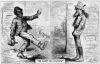
I watched this tribute to pioneer political cartoonist Thomas Nast on C-SPAN yesterday
Perhaps David Rees is one of the heirs to the tradition (though what he does is a strip, not the traditional one frame or whatever)?
Nast also designed the image of Santa Claus as we know him today.
Other sites on the influence of Nast on van Gogh and Degas (with a selection of Nast's work) and more toons.
8:48 PM - [Link] - Comments ()
An argument for sexually segregated colleges
The author is the president of an all-girls school, so her prejudice is to be expected. But if women do get less attention and acheive less in coed schools -- well more power to them.
I guess it's my age showing, but it always seemed weird to me that Douglass College (I went to coed Rutgers College, both of them part of Rutgers University) was still for women only. A relic of Victorian repression etc.
But in the context of women still not being accorded equality in American society, and this having a negative effect on their college experience, I can see why they might choose an all-woman school.
Though I still can't help but feel the old Victorian thing creeping back in, especially with the New Imperialism of the White House setting the tone.
2:48 AM - [Link] - Comments ()
Huh. The Oblongs have been on the Cartoon Network's "Adult Swim" since July
If I'da known, I'd have 'em all on tape by now.
1:26 AM - [Link] - Comments ()
Wednesday, January 01, 2003
Wardriving
Will net access thourgh ISPs (at least in cities) soon be a thing of the past?
2:17 PM - [Link] - Comments ()
FOUND magazine
article
1:33 PM - [Link] - Comments ()
Never did get around to reading Angry Young Spaceman, Jim Munroe's last novel, though I think it was available as a download and I have it somewhere on a disc. His new one Everyone in Silico may be good, but I have a feeling I'd probably agree with Donna McMahon that Pohl & Kornbluth's 1984 The Space Merchants does the job less self-consciously.
Munroe used to run Adbusters, and I kind of want to read him, but there's just too much to read now to tackle anything that isn't right on for me.
4:06 AM - [Link] - Comments ()

and s-integrator
@me
 Rarely has reality needed so much to be imagined.
--Chris Marker
Rarely has reality needed so much to be imagined.
--Chris Marker